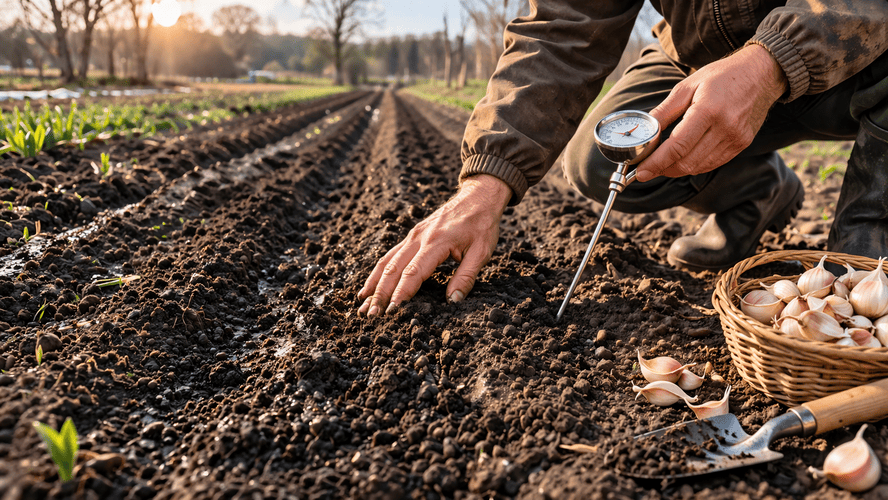
Many people are used to planting garlic in autumn, but spring planting can also deliver excellent results, especially if you want bulbs that store well until the next harvest. The main issue is that spring garlic does not tolerate delays. Even a slight delay can result in small, weak bulbs instead of large, dense ones. That’s why timing is critical.
How to understand that the soil is ready
The main indicator is not the calendar date but the condition of the soil. Garlic should be planted when the soil at a depth of 5–7 cm warms up to +3…+6°C. The soil should be moist but not frozen and not overly wet or muddy.
In southern regions, this happens in mid-March. In central regions, it is usually late March to early April. In western areas, planting often shifts to mid-April, while in northern regions it’s better to wait until the second half of April.
Simple ways to check if it’s time to plant
You don’t necessarily need a soil thermometer. There are simple practical methods.
Here are a few reliable options:
- use an outdoor thermometer, wrap it, and place it 7–10 cm deep in the soil for 10–15 minutes;
- grab a handful of soil – if it crumbles and your fingers don’t feel cold, it’s ready;
- observe birch trees – when buds start swelling, soil temperature is suitable.
Some gardeners simply rely on snow melting and soil drying slightly. If the ground is still too wet, it’s better to wait.
How to ensure large garlic bulbs
Even perfect timing does not guarantee a good harvest. Proper preparation is essential. Spring garlic requires attention to detail, but care is straightforward.
Key things to consider before planting:
- select large, healthy cloves without damage;
- soak planting material overnight in a disinfecting solution;
- prepare soil in advance with compost or humus;
- maintain spacing: 20–25 cm between rows and 5–6 cm between cloves.
Do not press cloves into the soil too hard. Place them carefully in furrows and cover lightly. After planting, mulch to retain moisture.
Spring garlic tolerates short frosts down to -3°C. However, late planting leads to excessive leaf growth instead of bulb formation.
For stable results, UDAZ offers professional support, planting material, and full-cycle cultivation services.